


How will you manage risk when the insurance market retreats?
Insurance is the load-bearing wall of the global economy. When climate change breaks the models, how will your business transfer risk?
N.B.: This article was first shared by Tim on LinkedIn
TL;DR
- Global insurance losses from natural catastrophes are outstripping premium growths. This gap is growing rapidly, creating a structural problem across the entire insurance industry.
- Private insurers are giving up on increasing premiums and beginning to retreat from entire geographies.
- When this happens, businesses and economies lose the risk-transfer mechanisms on which they rely, with catastrophic economic consequences.
- Despite the potential peril, businesses can prepare themselves with 6 key steps, outlined in this article.
Of all the climate-related risks facing businesses today, the uncertain future of the insurance industry might be the most under-discussed.
I’m not sure I have ever seen it appear in a corporate sustainability report or transition plan, which is very, very strange. In many ways (that we will get into), insurance is the load-bearing wall of the global economy. Remove it, or even significantly weaken it, and the financial structures on which we depend begin to collapse.
Stranger still, such a weakening is not some hypothetical scenario. Many forms or insurance are already under serious stress, with major providers admitting that climate change has effectively broken its models.
“We are approaching a tipping point where climate change renders whole sectors uninsurable. This is not a future risk – it’s already happening”
Mario Greco, Group CEO, Zurich Insurance Group (speaking in 2023)
Unsurprisingly, insurance companies themselves think a great deal about climate risk. For years now, they have been updating loss models, increasing premiums and beginning to exit the most volatile markets. And yet most corporate risk assessments seem to imagine that this is someone else’s problem.
(I suspect a big part of the reason why insurance is so absent from these assessments is that it barely features in the NGFS scenarios on which so many corporate climate risk analyses rely – but that’s another story.)
In this article, we’ll discuss:
- the many and growing vulnerabilities of the insurance industry to climate change;
- why this has material consequences for almost every business on earth, and;
- what you can do about it today.
Let’s start with some numbers
In 2025, Swiss Re reported that insured natural-catastrophe losses had exceeded $100 billion for the sixth year in a row. On average, nat-cat losses are now growing by 6-7% per year, significantly higher than the average growth in premiums.
In short: extreme weather events, increasing in regularity and severity, are causing severe stress in the underlying economics of the insurance market.
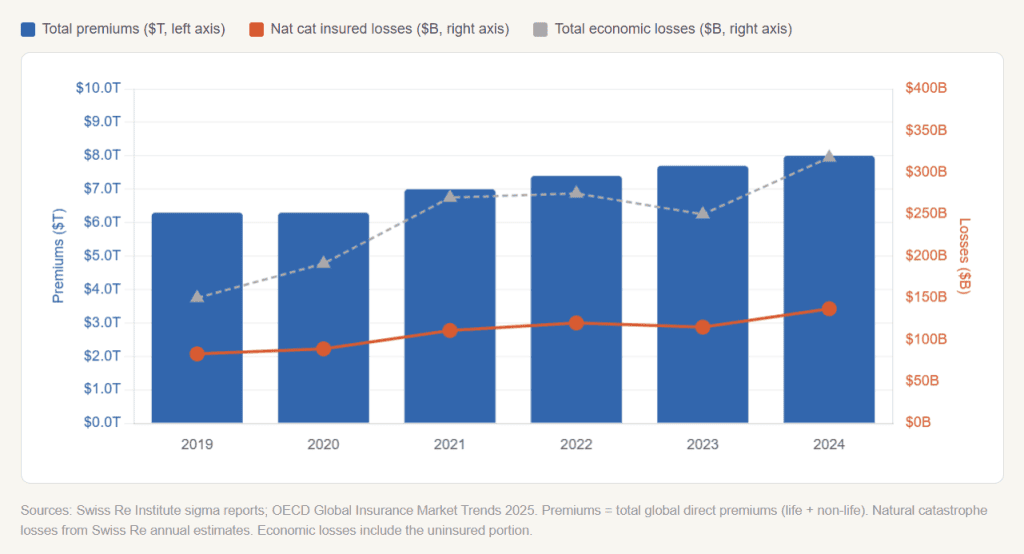
Looking ahead, the Swiss giants estimate a one-in-ten probability that global insured natural-catastrophe losses could reach $300 billion in a single year. Such an analysis means that losses on this scale are not some distant tail risk; they represent a plausible scenario for which the insurance world is readying itself.
Here’s one more that we’ll focus on later: the global insurance market holds investment assets of more than $40 trillion. By collecting premiums up front and paying claims later, insurance companies deploy large, long-duration pools of capital, making them vital, stabilising investors in capital markets.
Repricing, retreating and reinsuring
The rational response to rising losses has always been higher premiums. But as the nat-cat losses mount, insurance providers are increasingly deciding that market exit is their only option left.
Let’s take California as an example. Even before the devastating Los Angeles wildfires of 2025, years of mounting losses and actuarial uncertainty had prompted major US providers to give up on raising premiums and withdraw entirely from writing new policies in certain markets.
For most Californians, this leaves the state-backed FAIR Plan as their insurer of last resort. In 2018, it had 140,000 members. It now covers over 600,000 homeowners.
Following the LA wildfires, which caused an estimated $40 billion in insured losses, the FAIR Plan was forced to request a $1 billion bailout to cover claims that exceeded its reserves. Even in California, the world’s 4th largest economy, such losses are not sustainable. More than thirty states, many of them far less well-resourced than their west-coast cousins, have established similar last-resort programmes. Designed as safety valves, these plans are becoming necessary (but vulnerable) structural pillars for entire state economies. This is a market already beginning to falter, with major consequences for public finances.
The size of the US economy and the volatility of its climate mean that >80% of global insured losses occur there. Misquoting a 19th century Foreign Minister of the Austrian Empire, it is sometimes said that “when America sneezes, the world catches a cold”. If things carry on unchanged, we would all do well to prepare for the most dizzying bout of flu.
When insurance leaves a market, the consequences are systemic and structural
Since the first modern forms of insurance emerged in London in the late 17th century, businesses have come to treat insurance as a cost item and a risk managed. The premiums go up and everyone grumbles, but budgets adjust and business continues more or less as usual. This approach will not survive contact with a 2°C+ warming trajectory.
What we need to imagine is not a continuation of a gradual premium inflation, but the disappearance of the risk transfer mechanism itself. The reality is that most of our corporate and financial systems have not worked out how to conduct business in a world in which many assets and activities become uninsurable.
And it does not take an economist to imagine how the consequences cascade when insurers leave a market. As an example, let’s imagine what happens when home insurance retreats from a market:
- Without insurance available, lenders get shy and mortgages stall.
- With far fewer buyers in the market, house values fall.
- The incentive to build homes evaporates and all of the economic activities that rely on construction grind to a halt.
- With confidence in the market undermined, a downward spiral begins with no obvious way out.
- Such is the importance of mortgage-lending and house building to national economies, the impacts spread and cascade throughout the economy.
Once again, the US gives us the best current example of this phenomenon: in Miami-Dade County, Florida, the average home insurance cost is now $17,000 per year with First Street predicting that this cost could triple over the course of a 30-year mortgage. After Hurricane Debby made landfall in 2024, Florida’s state-backed insurer of last resort rejected 77% of associated insurance claims. In the Florida housing market at least, the cycle has begun.
A similar cycle could play out in every industry that relies on insurance to manage the risk of lending and investment. That’s virtually every major industry on earth.
It doesn’t take long for the impacts to hit the public purse either. Without private forms of insurance in place to mitigate risk, the cost of natural catastrophes falls on government relief. The reality however is that this will never be sufficient. When Hurricanes Helene and Milton struck Florida in 2024, FEMA’s response was criticised for being wholly inadequate. And yet, just eight days into the fiscal year, that inadequate response had exhausted nearly half of the agency’s entire annual disaster relief budget.
So what on earth should businesses do?
Such systemic risks can feel overwhelming. However, the most effective response is to position the unavailability of insurance as a constraint to be actively managed.
My favourite example of this is the Australian forestry industry, where the ever-present threat of wildfires means that insurance premiums have been largely unaffordable for some time. The response has been to invest the money that would otherwise have been used to pay premiums into private fire services, creating a substantial line of defence in the absence of financial risk mitigation. It is a brilliantly practical way of dealing with an abstract, financial issue.
In any case, there are some important steps any business can take to reduce structural dependence on a market that is becoming less reliable. Here’s how you can get started:
1. Map your insurance exposure properly
Most organisations have a reasonable view of their own insurance arrangements, but very few understand their indirect insurance exposure. A key supplier operating in a high-risk geography that loses property coverage or business interruption insurance is an operational risk to your business, whether or not you own a single asset in that geography.
Start with a geographic concentration analysis: where do your owned assets, your critical suppliers and your key customers sit in relation to markets where insurance is already deteriorating? The US Gulf Coast, California, coastal Florida, as well as large parts of Southeast Asia and sub-Saharan Africa are the most acute right now. Consider a forward-looking view too, using physical climate modelling to draw out areas that will likely become higher risk in the near future.
2. Stress-test your financing against insurance withdrawal
Debt covenants, project finance structures and lease agreements almost universally contain insurance requirements. If insurance in a geography becomes unavailable or unaffordable, those requirements may be met, triggering potential default events unrelated to the underlying operational performance of the business.
Finance teams should be reviewing debt documentation to understand what what happens to our covenant compliance if we cannot obtain adequate insurance coverage for a material asset? For new financing arrangements, seek to negotiate force majeure carve-outs or insurance alternative provisions that address the scenario of market-wide coverage withdrawal.
3. Invest in physical resilience as an insurance substitution
The conventional business case for physical resilience investment has typically been framed in terms of reducing insurance premiums. As insurance becomes unavailable rather than merely expensive, physical resilience becomes a way to reduce the need for insurance altogether, as in the Australian forestry example earlier.
By investing in physical resilience against climate impacts, you are simultaneously reducing loss exposure, improving insurability in a tightening market and building the kind of operational continuity that lenders and investors prioritise.
4. Diversify your geographic and supply chain footprint
New capital allocation decisions should incorporate insurance availability and trajectory as an explicit location factor, alongside labour costs, logistics, and regulatory environment. A geography that is becoming uninsurable is, in most cases, also becoming progressively harder to finance, harder to recruit into and harder to exit from at full value.
Concentration risk in high-exposure geographies creates strategic vulnerability. For businesses with manufacturing, sourcing, or distribution concentrated in regions facing escalating climate risk, the case for geographic diversification is now acquiring a new and more urgent dimension.
5. Explore parametric insurance products to transfer risk
Parametric insurance products, which pay out against a defined physical trigger (rather than assessed loss), have been growing as a complement to conventional coverage in high-risk markets. Unlike traditional indemnity insurance, parametric products can be structured, priced and paid rapidly. They are not a wholesale substitute for conventional coverage but they are a meaningful supplement in geographies where conventional coverage is deteriorating.
6. Engage your board and risk teams
Climate risk assessment has often fallen by default to sustainability teams that are simply not structured to manage a scenario in which a material asset becomes unfinanceable because no insurer will cover it. This is a failure of governance.
Insurance availability risk belongs on the risk register, in the treasury function and in front of the board’s audit and risk committee. The question is simple: which of our assets, operations and key partners could become uninsurable within a five-to-ten-year horizon, and what is the financial consequence if they do? That question deserves a quantified answer, a mitigation plan and a named owner.
The collapse of insurance as a functioning risk-transfer mechanism is no longer a distant tail risk. It is already underway in specific geographies and will continue to develop at different speeds in different geographies and industries.
If you need support to understand and manage your organisation’s exposure to insurance market withdrawal, we’re here to help.



Leave a Reply